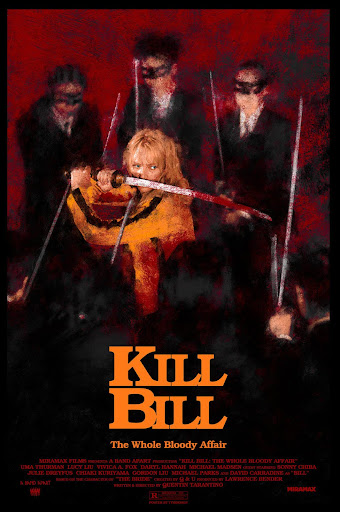
“When I arrive at my destination, I am gonna kill Bill.” It was these words that defined Quentin Tarantino’s artistic, revenge-driven film duology, Kill Bill. “I’ve always thought the Kill Bill films were some of Tarantino’s most stylistically bold work,” stated Ramapo history teacher Mr. Verdon. “The acting is outstanding, and the films strike a great balance between homage and originality.” A blend of spaghetti western and samurai genres, and featuring a powerful female protagonist in the male-dominated revenge genre, the Kill Bill films are widely acclaimed. They earned a combined $330 million at the worldwide box office upon release, according to The Numbers. Their impact cannot be overstated, with the iconic yellow tracksuit that Uma Thurman’s character wears in the film becoming a recognizable symbol in pop culture.
Kill Bill: Vol. 1 and Vol. 2 were originally intended to be a single film with a runtime of four and a half hours, but they were bifurcated into volumes to make it more palatable for audiences. However, as of December 5th, the original, uncut version of the film—Kill Bill: The Whole Bloody Affair—has been released to theaters, featuring scenes that were previously cut from the original halves.
The two Kill Bill films follow Uma Thurman’s character, The Bride, a former assassin from The Deadly Viper Assassination Squad (DVAS), led by her ex-lover Bill. She left to start a new life where she could raise her unborn daughter alongside her new fiancé. Feeling as though The Bride abandoned them, Bill and the DVAS try to murder her on her wedding day, killing her wedding guests, her fiancé, and putting her in a coma that she would not wake from for four years. When The Bride wakes up in the hospital, she vows to kill those who ruined her dream of a new life and creates a hit list of all the DVAS members: O-Ren Ishii, Vernita Green, Budd, and Elle Driver. The final name on the list reads “BILL.”
In the typical Tarantino fashion, the film is very gory, but in a highly stylized and cartoonish way. The excessive, bright-red blood spurts make it almost comical, mimicking a visual effect used in Japanese cinema. Asian cinema influences can be seen everywhere, from The Bride’s weapon of choice being a katana, to her training in China, and her martial arts fighting style. There is even an anime sequence, a scene that was cut down in the original films, but is now shown in its entirety in Kill Bill: The Whole Bloody Affair.
Fans feel that this new extended edition makes The Bride’s journey all the more emotional and impactful. “While I appreciate the two-part release,” commented Mr. Verdon, “I think there’s something compelling about seeing the entire story as one complete film. The traditional story arc that audiences expect can feel slightly disrupted when a single narrative is broken into two pieces. Watching it as one continuous film restores that full build-up, climax, and resolution without interruption.” Some cling to nostalgia and prefer the two-film format better, while others rave about the four and a half hour movie’s depth, but Ramapo physics teacher Mr. Gilgur noted that he enjoys both versions. When it comes to movies, he explained, “I like to watch the shorter version first, to see if I like it, then commit to the longer version. Watching two movies together as one is something I don’t mind. I am very interested to see how [Tarantino] cuts both movies into one continuous flow without credits in the middle.” While some may disagree on which version is better, there is no denying the cultural impact of the artistic masterpiece that is Quentin Tarantino’s Kill Bill.
Finally, as the final title card in Kill Bill: Vol. 2 reads, “The [lion] has rejoined [his] cub, and all is right in the jungle.” Quentin Tarantino’s release of Kill Bill: The Whole Bloody Affair allows audiences to experience the film as he always intended it to be seen: uncut and unfiltered.