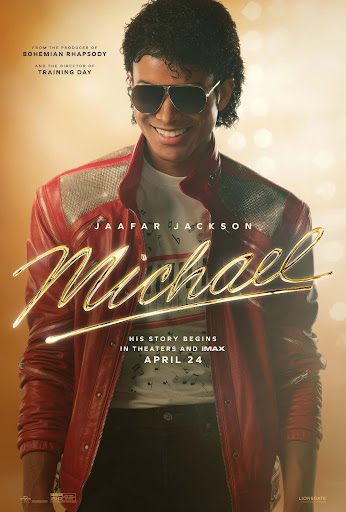
Over four decades after its release, Michael Jackson’s hit single “Billie Jean” became number one on the Billboard Global 200 chart in mid-May, making it the oldest song to ever reach this position (Billboard). This achievement comes after the release of a biopic about the popstar, simply titled Michael. While the film has brought even more success to the already iconic King of Pop, many have mixed feelings about this sanitized depiction of his life.
Michael begins in 1968, exploring Jackson’s humble beginnings in Gary, Indiana as a part of the Jackson 5. However, the pop star’s famous sister, Janet Jackson, is notably absent from the entirety of the film, as are his other siblings, Randy and Rebbie.
Later in the movie, in 1978, Jaafar Jackson—Michael Jackson’s real-life nephew—takes over the character as an adult. He gives an undeniably stellar and uncanny debut performance, mastering his uncle’s dance moves, voice, and mannerisms. The story itself, however, is expectedly formulaic, often on the same wavelength as producer Graham King’s other biopic, Bohemian Rhapsody, which relies solely on nostalgia and famous songs to draw in audiences. Similarly, Michael serves as a vehicle to showcase the star’s greatest hits.
The movie’s story ends in 1988, right before allegations begin to tarnish the singer’s reputation. According to The Guardian, the original movie script went further into the pop star’s life and even addressed the 1993 child sexual abuse lawsuit. However, Leaving Neverland director Dan Reed claimed it “rewr[ote] history” and “distort[ed]” the truth. Due to a legal clause in the lawsuit, the ending had to be reshot to what it is now. Variety suspects that it was also these legal barriers that resulted in Diana Ross being removed from the film—a role that had to be cut due to “certain legal considerations.” As a result, the film does not reference The Wiz, a 1978 reimagining of The Wizard of Oz with an all-African American cast where Michael Jackson portrays the Scarecrow, and Diana Ross plays Dorothy Gale.
Evidently, there are many pieces missing from this story. Ramapo social studies teacher Ms. Gregory commented, “I’m not a fan of his, and I think the movie isn’t a 100% accurate depiction of who he was or what his life was like!” In its attempts to humanize Jackson, the movie instead glorifies him as infallible, failing to give him the true depth and flaws that human-beings possess.
Michael is enjoyable, safe, and, according to Paris Jackson, a “sugarcoated” retelling of her father’s life filled with “full-blown lies.” Regardless, the movie has been a hit among audiences, grossing approximately $800 million worldwide (The Numbers). Many fans celebrate the film as a testament to the King of Pop’s hits, such as Ramapo junior Olivia Mitarotonda who exclaimed, “I thought it was really great to see his nephew take on the role. The movie brought Michael Jackson back to life!” It has gained a lot of attention on social media as well, making the already renowned pop star even more famous among younger audiences.
While it is an enjoyable film, Michael should not be treated as an entirely accurate depiction of the star’s life. “His story,” explained Ramapo history teacher Mrs. Vander Molen, “is deeply complex and difficult to reconcile.” The film glosses over the star’s layered and complicated tale. It is expected that the Jackson estate would want to protect his reputation, but it has left critics wondering just how airbrushed and altered future depictions of his remaining years will be.