On April 11, 2026, NASA’s completed Artemis II 10-day mission shaped the future of space exploration and successfully validated the Orion spacecraft’s system, crew operations, and overall mission to prepare for the next Artemis launch, scheduled for 2027. The four brave astronauts, Reid Wiseman, Victor Glover, Christina Koch, and Jeremy Hansen, put the Orion spacecraft through a series of planned tests to evaluate systems, procedures, and performance in deep space (NASA). This was NASA’s first crewed mission to the Moon in over 50 years, and a great deal of data is currently being evaluated and assessed.
The Artemis II test flight successfully began a new era of exploration, laying the groundwork for the third Artemis mission next year, lunar surface missions, a Moon base, and future missions to Mars (NBC). However, the one concrete element which is broadly noted with great emotion and pride is the bond and human connection between the four astronauts. From a technical and performance-based perspective, the astronauts practiced critical mission activities, including trajectory adjustments, communications at lunar distances, and piloted Orion during key phases of flight, culminating in a re-entry and splashdown to further validate the spacecraft’s performance with crew aboard (NASA). From a personal perspective, the gratitude, emotion and bond presented between the four astronauts was undoubtedly brought to the forefront of the mission.
“We are bonded forever, and no one down here is ever going to know what the four of us just went through, and it was the most special thing that will ever happen in my life,” Wiseman said. Glover added, “Even bigger than my challenge trying to describe what we went through, the gratitude of seeing what we saw, doing what we did, and being with who I was with. It’s too big to just be in one body” (NBC).
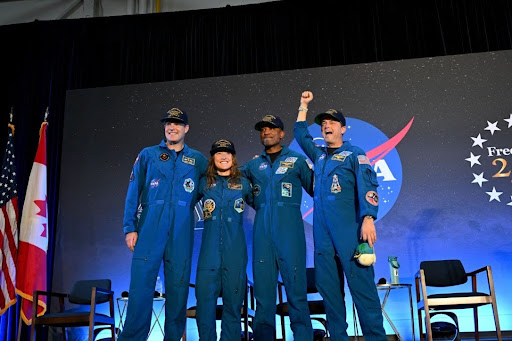
colleagues after they landed at Ellington Airport on April 11, 2026 (NASA).
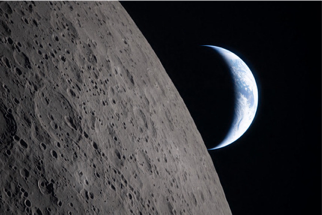
The mission’s milestones were endless and the visuals captured and presented in the media stretch far beyond what we have seen before. The four astronauts
also set a record for the farthest distance humans have traveled from Earth: 252,756 miles. The previous record of 248,655 miles was set by the crew of Apollo 13 in 1970 during its emergency return to Earth. There were other historical firsts as well: Koch was the first woman, Glover the first person of color, and Hansen the first non-American on a lunar mission (NBC).
Mr. Jaeger, Ramapo’s biology teacher, remarked, “I think it’s really cool we are going back to the moon. NASA is trying to mine helium three on the moon, and we can use it for fusion reactions!” Adding on to the excitement, Ramapo senior, Lana Jepsen, commented, “The remarkable success of the Artemis II mission is an amazing milestone for NASA that inspired hope and a sense of patriotism throughout the country, and will no doubt strengthen their path towards more advanced space exploration!”
The human connection and successful mission was equally as impressive as the detailed space observations and beautiful imagery. The mission should prompt us to take a good look at how small our planet really is, and appreciate the importance of our place in the solar system.