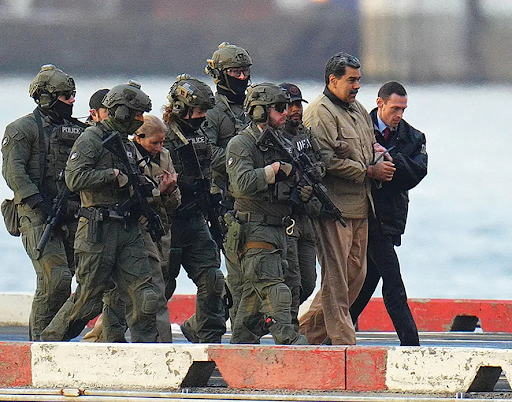
The world woke to a geopolitical earthquake on January 3, 2026, when the United States government executed a dramatic military operation in Caracas, Venezuela, resulting in the capture of Venezuelan President Nicolás Maduro and his wife, Cilia Flores. In a move unprecedented in modern U.S.–Latin American relations, U.S. forces seized the leader on accusations of narco-terrorism and drug trafficking (CNN News).
This U.S. operation did not come without precedent for the Trump Administration. President Trump has worked to crack down on drug trafficking in South America since his first presidential term (PBS News). Since returning to office in January of 2025, Trump has made slow but significant moves toward advancing his anti–drug trafficking agenda.
For much of the 20th century, Venezuela and the United States maintained a strong and mutually beneficial relationship centered on trade and oil. Hostility between the two nations is a relatively recent development, intensifying after Hugo Chávez took power in 1999 (Catalyst Planet).
More recently, relations between the United States and Venezuela have become increasingly strained as the Trump Administration adopted a more aggressive approach to transnational crime. This included an executive order allowing criminal organizations, such as the Venezuelan gang Tren de Aragua, to be labeled as “foreign terrorist organizations” (PBS News).
The administration accused President Nicolás Maduro’s government of cooperating with these groups to facilitate drug trafficking and illegal immigration, though U.S. intelligence agencies disputed these claims. This shift marked a move away from diplomacy and law enforcement toward a strategy that justified military action, leading to an expanded U.S. military presence and strikes against vessels accused of drug smuggling. The administration argued that the United States was engaged in an armed conflict with drug cartels, classifying them as unlawful combatants—a stance that drew criticism from lawmakers, international organizations, and human rights groups over concerns about transparency and civilian harm. Additional restrictions on Venezuela’s oil exports further worsened relations, despite occasional indications from both governments of a willingness to engage in dialogue (PBS News).
Senior at Ramapo, Emma Sanchez, stated, “The situation in Venezuela has changed really quickly since the U.S. got involved, and it’s hard to tell what the long-term impact will be. A lot of people seem unsure about what comes next for the country.” Fellow senior, Emily McCarthy, added, “With President Maduro being taken into U.S. custody, there’s been a lot of discussion about foreign intervention and leadership in Venezuela. It’s a complicated situation, and there are many different perspectives.”
Trade mismanagement, hyperinflation, massive shortages, and misguided price and currency controls under Hugo Chávez, and later Nicolás Maduro, have contributed to economic collapse and widespread suffering for the Venezuelan people.
The United States’ capture of President Nicolás Maduro is viewed by some as both a potential turning point and a cause for concern for the Venezuelan people. Rampant violence, gang warfare, and soaring crime rates have forced mass displacement, with many Venezuelans seeking asylum in neighboring South American countries and the United States (UNHCR). Others remain wary of how U.S. involvement may shape Venezuela’s future, raising questions about whether this intervention will follow patterns of past U.S. actions in Latin America and how it may affect regional relations.
As Nicolás Maduro and his wife, Cilia Flores, remain in custody in New York City, ongoing legal proceedings will seek to determine the extent of any connections between Maduro and drug-trafficking operations.