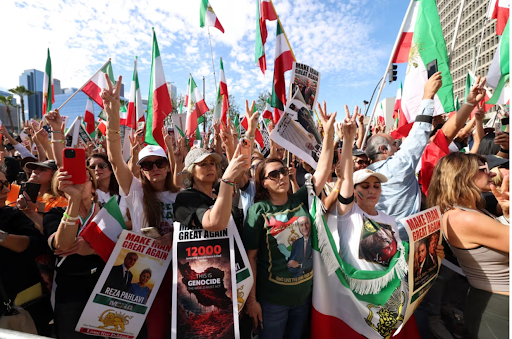
Protests in Iran began in December over economic hardship, inflation, and public dissatisfaction with the Iranian government. The Iranian economy has been strained for years, partly as a result of United States and European involvement in nuclear sites. After decades of territorial and ideological disputes, Israel bombed Iran in June of 2025, carrying out 360 attacks over the course of 12 days. The aftermath of this conflict continues to create tension and economic depression in the Middle East, further contributing to recent protests. As public unrest grows, protests have quickly become a broader criticism of the Iranian government (ACLED).
Most of the protesting has occurred on the streets of Tehran, the capital of Iran. Protests have resulted in thousands of casualties throughout the last month, including both civilians and members of the security forces. In the last few weeks, the Iranian government has responded with a crackdown on communication and internet services. According to the New York Times, “The government initially signaled a willingness to listen to protesters and announced plans to provide most citizens with a monthly payment equivalent to about $7. But Iranian officials then hardened their stance, an echo of previous rounds of unrest when the authorities used mass arrests and violence to suppress demonstrations.”
Mr. VanderMolen, AP Government and Politics teacher at Ramapo, shared, “Unrest can weaken economies, erode trust in government, and lead to long-term instability or authoritarian responses. The events happening in Iran are cause for concern, although no one knows the exact number; reports are that thousands of people have been killed in Iran as a result of these protests.” In the past few days, internet connectivity has gradually returned. More than 3,900 protesters and about 180 security forces have been killed since the protests began, according to the U.S.-based Human Rights Activists News Agency. The group is still working to verify more than 9,000 other reported deaths. Jackson Rijo, a current senior at Ramapo, commented, “It’s awful to think that many lives were lost in the process of fighting for rights and protections.”
President Donald Trump repeatedly threatened to intervene with military force during the brunt of the protests, but has since withdrawn his statement. The administration has made it clear they would be willing to negotiate with the Iranian government in the interest of protecting protesters. The United States’ interest in the conflict has sparked controversy, as Ayatollah Ali Khamenei, the Supreme Leader of Iran, has accused the United States and Israel of instigating protests. Since then, the Iranian government has coined the protests “sedition,” claiming them to be a continuation of the 12-day war Israel launched against Iran last June (ACLED).
A heavy military and security presence remains across many cities and towns, and thousands of people have been detained. President Trump has announced that the killing of protesters in Iran has stopped, but the Iranian government still plans to draw a distinction between protesters and rioters. The Iranian government announced that the execution of “rioters” will still be carried out. “We do not seek to lead the country toward war,” Mr. Khamenei, the Supreme Leader, said on Saturday, “but we will not let domestic criminals go unpunished” (New York Times).
Although unrest in Iran seems to have quieted, the uncertainty of both their domestic state and international relations remains.