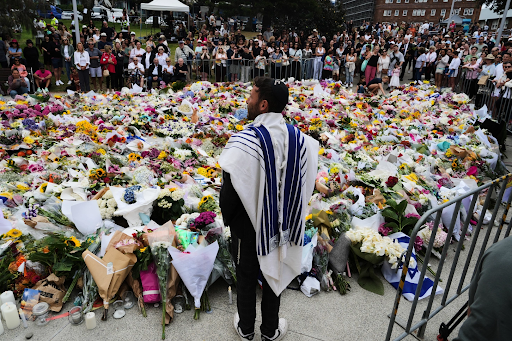
On December 14th, two gunmen opened fire during a Hanukkah celebration, “Chanukah by the Sea” at Archer Park near Bondi Beach in Sydney, Australia. At least 15 people were killed, and more than 40 people were wounded in serious condition. Among those killed were various community members, including a 10-year-old girl, and a Holocaust survivor who was a grandfather of 11 (ABC News).
Authorities say the attack was carried out by a father and son. The 50-year-old father, identified by a police report as Sajid Akram, was shot and killed by police, and his 24-year-old son was wounded and taken into custody (Reuters). According to the New York Times, “The man, identified in the charge sheet as Naveed Akram, faces 59 charges in all, including displaying a symbol of a terrorist organization and placing explosives with the intent to cause harm.” The younger suspect had been in a coma since Tuesday afternoon, according to Mal Lanyon, the police commissioner for the state of New South Wales. The suspect is still being hospitalized and under police guard. He had a bail hearing on Wednesday through video link, where no bail was requested, according to a charge sheet from the court (NY Times).
Australian police and government officials have classified this mass shooting as a terrorist attack motivated by antisemitism. Flags linked to the Islamic State (ISIS) were reportedly found in one of the attackers’ vehicles. Improvised explosive devices were also discovered nearby (AP News).
English teacher and advisor of the Jewish Culture Club at Ramapo, Ms. Schwarz stated, “Grouping the Bondi Beach shooting with other recent instances of gun violence can obscure the ongoing issue of extremist indoctrination and the deliberate targeting of the Jewish community. Over the past year, the Australian Jewish community has experienced arson attacks on synagogues and Jewish schools; this attack did not occur without warning signs.” Her statement voices the concern of many that the Bondi Beach attack should be understood within a broader pattern of targeted antisemitic violence, rather than treated as an isolated act of gun violence.
The prime minister of Australia, Anthony Albanese, said at a press conference, “This is a targeted attack on Jewish Australians on the first day of Hanukah, which should be a day of joy, a celebration of faith”(The Guardian).
Australia’s leaders have praised a bystander who tackled one gunman and disarmed him during the attack. Footage has surfaced on the internet of the incident showing a man who was later identified as 43-year-old Ahmed al Ahmed pouncing on the gunman from behind a parked car. Successfully wrestling the large weapon from the gunman’s hands, the attacker was forcibly disarmed and cornered by Ahmed. Through his brave, heroic act, Ahmed al Ahmed suffered gunshot wounds to his shoulder and hand. His intervention in the attack has become widely praised around the world, and many are monitoring his recovery (Financial Times).
This recent attack has reignited discussion surrounding the ongoing concerns of gun safety and firearm regulation, as well as antisemitic sentiments. The shooting has been declared as Australia’s deadliest open fire attack in nearly 30 years, prompting renewed calls from political leaders, advocacy groups, and community members to reassess existing gun laws and security measures to prevent future acts of violence. The Bondi Beach shooting, classified as a terrorist attack that killed and injured dozens, has led to national mourning across Australia and heightened security (ABC News).
As investigations continue, Jewish communities in Australia and around the world are grappling with renewed fears over safety and the rise of extremist violence. The tragedy at Bondi Beach stands as a reminder of the urgent need to confront antisemitism and strengthen protections to prevent such attacks from occurring again.