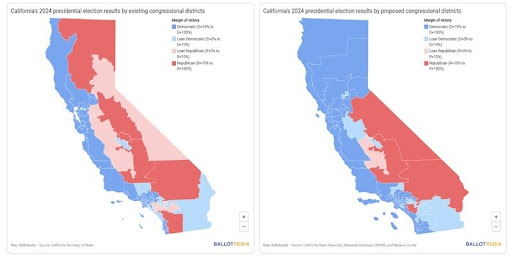
On November 4th, 2025, California voters overwhelmingly approved California Governor Gavin Newsom’s measure that allowed the state to redraw its congressional map in favor of Democrats. This proposition came as a direct response to efforts by President Trump and state leaders in Texas to redraw Congressional district lines in Texas to gain five more Republican seats in the House of Representatives. California’s rebuttal would nullify these votes and help Democrats to gain a majority in the House.
President Trump threatened to challenge California’s mail-in-ballot results before the vote was finalized, claiming that the special election was fraudulently conducted. According to CalMatters, the President said there would be “a very serious legal and criminal review” of the state’s use of universal mail-in ballots.
White House spokesperson, Karoline Leavitt, later said Trump was working on an executive order to strengthen elections and assure there isn’t “blatant fraud” in California’s universal mail-in ballots (CalMatters).
For more than a decade, the majority of voters in California elections have participated by mail. Voter fraud is extremely rare, and studies have found no evidence that voting by mail increases fraud. However, the President’s accusations and the combative nature of the proposition itself perfectly capture the tense and belligerent polarization of U.S. politics today. Ava L’Heureux, a current senior at Ramapo, shared, “I think that Prop 50 is another example of how divided our government is right now.”
Proposition 50 ultimately reflects a broader debate about accountability and transparency. Supporters argue the measure provides a block against corruption, while critics worry it could be misused for political gain. Gavin Newsom’s actions as Governor, and the actions taken by Texas in redrawing Congressional district lines, have highlighted how both parties are focused on gaining political control as much as they can instead of working together.